North and South Carolina Dive Sites: Explore the Graveyard of the Atlantic
Welcome to some of the most dynamic and exhilarating scuba diving on the East Coast. Here off the Carolina coast, the warm, clear waters of the Gulf Stream collide with historic coastal currents, creating a world-class diving environment teeming with life. Known globally as the Graveyard of the Atlantic, our waters hold centuries of maritime history, offering divers unparalleled access to pristine historical shipwrecks, deep-water ledges, and thriving artificial reefs.
Whether you are looking to encounter majestic sand tiger sharks, navigate iconic WWII wrecks, or explore vibrant local ledges, our coastal waters offer an unforgettable adventure for every level of training.
Explore our favorite local dive sites below and find your next underwater destination.
(Thank You to the various sources and websites used to compile thisinformation)
Choosing Your Next Adventure
To help you plan a safe and unforgettable day on the water, we categorize our dive sites by the recommended training and experience required to dive them comfortably. Take a look at the table below to match your current certification and comfort level with the depths, currents, and conditions of each site. If you spot a wreck or ledge you are dying to explore but don’t quite have the rating for yet, let us know—we love helping divers level up their skills and earn the advanced or specialty certifications needed to get there!
| Diver Experience Levels | Dive History | Certifications Available | Depths |
|---|---|---|---|
| Less Experienced Diver: LE | Open Water Certified with less than 10 Carolina Coast boat dives. | Checkout Dives 3 and 4; Advanced Open Water Certification; or Wreck Specialty Certifications | 50 to 80 feet |
| Intermediate: I | Advanced Open Water or Deep specialty certifications (or equivalent dive experience) and at least 2 previously logged dives deeper than 80 feet offshore in the past year. Divers are required to dive Nitrox | Advanced Open Water, Deep or Wreck Specialty Certifications. | 60 to 100 feet |
| Experienced: E | Must have Deep and Wreck specialties (or equivalent dive experience), at least 50 logged dives, and at least 4 previously logged dives deeper than 100 feet offshore in the past year. Divers are required to dive Nitrox AND carry alternate airsource. | Deep or Tec 40/45/50 | 80 to 132 feet |
Aeolus - Experience Level: I
This vessel was sunk in 198 as part of North Carolina's artificial reef program. It is a 409-foot tanker that lies at a depth of 110 feet. As a result of hurricanes in 196, this ship has been split into three portions and has also partially been turned to an upright position - making it an excellent multi-level dive. On occasion, the site has become inhabited by a few sand tiger sharks. Experience Level: I
BP25 - Experience Level: I
The BP-25 Artificial Reef is a well-known offshore reef site off the South Carolina coast, created using a large steel barge designated BP-25. Unlike wartime wrecks lost to combat or accidents, BP-25 was intentionally deployed as part of South Carolina’s artificial reef program to enhance marine habitat and provide offshore fishing and diving opportunities.
The barge was carefully prepared and sunk in deep offshore waters, settling upright on the seafloor and creating substantial horizontal structure. Sitting in approximately 95–105 feet of water.
Over time, BP-25 has developed into a productive reef system. Its broad steel deck and open framework create shelter and vertical relief that attract schools of baitfish, which in turn draw in larger predators. Divers commonly encounter amberjack, barracuda, spadefish, snapper, grouper, and seasonal pelagic species. While sharks are not guaranteed, encounters with sand tiger sharks and other large marine life are not uncommon, especially during peak seasons.
Today, BP-25 is valued not for historical drama, but for what it represents: a successful transformation of industrial maritime structure into a thriving artificial reef. For divers, the site offers a classic blue-water Atlantic experience—big structure, big life, and the excitement that comes with exploring a remote offshore reef built specifically for the ocean to reclaim.
Caribsea -Experience Level: I
This ship was a WWII freighter that transported materials along the Eastern Coast. The ship had no arms at the time of its attack, leaving her defenseless. It was torpedoed on March 11, 1942, and lies in 90 fsw; and is populated by sand tiger sharks. With large groups of spadefish, baitfish, and amberjacks, this site is popular for its frequent visits of stingrays and cobia. Experience Level: I
Cassimir - Experience Level: E
Farb: "One of the top five dives off the North Carolina Coast." p 235. The Cassimer transported molasses from Baltimore to Cuba to be used in the rum-making process. On the morning of February 26, 1942, the Cassimir was moving through a dense fog when it hit another freighter that was also moving through the fog. Both vessels were running quite and fast to avoid U-boats. There is a gash in the starboard side of the Cassimer, causing it to sink. Visibility averages 70 feet but can get up over 100 feet. Large schools of amberjack and spadefish can be seen swimming around the wreck. Tropical fish, such as the Queen Angel, can also be seen regularly. Experience Level: E
Charleston Tug - Experience Level: LE
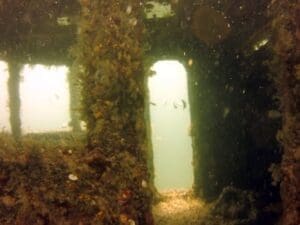
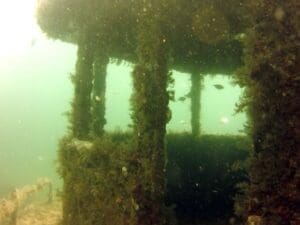
Resting upright just off the coast of North Myrtle Beach lies a spectacular 130-foot tugboat artificial reef. Sitting in 62 feet of water with its superstructure rising to a shallow 30 feet, this site proudly boasts some of the most best inshore visibility in the area. Because the wreck's deck sits well within shallow recreational limits, it provides the perfect, controlled environment for Open Water students to safely complete their check-out dives 3 and 4.
The wreck has transformed into a bustling marine highway. As you explore the vessel, expect to encounter resident Grouper, schooling Barracudas, Spanish Mackerel, Spadefish, Oyster Toad Fish, and Black Sea Bass, while sharp-eyed divers can spot tiny Gobies and the occasional hidden Octopus.
As a unique bonus, the dive also features an adjacent field of submerged Armored Personnel Carriers (APCs) just waiting to be explored.

Open Water Students can complete checkout dives 3 & 4 on the Charleston Tug.
This is also a fantastic site for Wreck Diving Specialty and Advanced Open Water. Experience Level: LE
City Of Houston - Experience Level: E
An amazing dive. She is an ironclad steamer that went down in a storm in 1878. Artifacts are still being found on her as the sands shift and reveal new areas. Clearwater, dense schools of fish, just fabulous. One of Captain Jim's favorite dives. COH lies in 95 feet of water. Experience Level: E
City Of Richmond - Experience Level: I
A five-deck passenger ship that sank during a storm while being towed the Virgin Islands. Lots of grouper, snapper, and triggerfish can be found on this wreck. The shallow depth of 50 feet makes it a good spearfishing choice for less experienced spearfishers. Experience Level: I
Dredge Wreck - Experience Level: LE

The Dredge Wreck is about 14 miles from Masonboro Inlet in 65 ft of water. It is in close proximity to the Stone tug and the Pocahontas. The name of the Dredge Wreck is the Playa an 800-ton dredge. It sunk in February 1931 while being towed to Morehead City. A month after the sinking of the Playa, the Coast Guard dynamited the wreck so it wouldn't be a hazard to navigation.
This is a cool little dive. The entire wreck can easily be explored on a single dive. The most noticeable part of the wreck is the thousands of bricks lying all over the site. As you swim beyond the bricks you run into the engine and then into a long boom that stretches out over the sand. Wreckage is scattered around the perimeter and wood timbers can still be seen rising from the sand. Lots of life congregates around the wreck due to all the places to hide between the scattered bricks and rusted out engine. During the summer white grunts cover the entire wreck in what I think is a spawning aggregation
Ed's Lobster Wreck - Experience Level: E
Ed's Lobster Wreck: It has been suspected for a while that the "lobster wreck" was a dredge. Recently, there was a confirmation of that suspicion, plus a probable identification. In August 2000, Bryan Tate of Wilmington, NC, found the windlass/winch from the "lobster wreck." On the winch, Bryan found the nameplate for the Ellicott Machine Company. The Ellicott Machine Company is still in business, and after some correspondence, a company representative matched the contract number and reported to Bryan that the winch was originally installed on the dredge, Porta Allegra. The Porta Allegra was built around 1908 and was outfitted with a 20-inch cutter. The wreck is home to a large population of Spiny Lobsters. Recently, the wreck has been invaded by lionfish. The "Lobster Wreck" is one of the more beautiful dives off of North Carolina. This wreck is great for spearfishing grouper and lionfish. The boat ride is almost 3 hours each way. Depth is 95 to 130 feet. Experience Level: E
Fossil Ledge/Megalodon Teeth Ledge - Experience Level: I
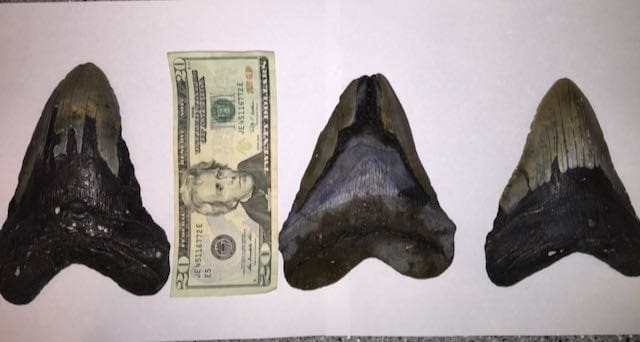
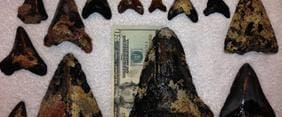
The Fossil Ledge is known for its large quantity of shark teeth and whale bones. A lot of Megalodon and other various sharks' teeth litter the bottom. There are also a bunch of fossil whale bones, including ribs and huge vertebrae. Some areas of the fossil ledge are the prettiest ledges in the Carolinas. Experience Level: I
Hebe - Experience Level: E
The SS Hebe also know as the Twin Cities Wreck, was a Dutch merchant freighter operating during World War II and is remembered today as one of the notable WWII-era wrecks off the South Carolina coast. In the spring of 1942, the U.S. East Coast was under intense threat from German U-boats during Operation Drumbeat, forcing Allied and neutral vessels to travel under strict blackout conditions at night to avoid detection. On April 11, 1942, while steaming without lights in these dangerous conditions, the Hebe collided with the British armed trawler HMT St. Cathan. The impact was catastrophic. The collision caused severe structural damage, and both ships sank as a result of the accident rather than enemy action. Remarkably, all 31 crew members aboard the Hebe survived, while the St. Cathan suffered significant loss of life, with most accounts reporting around 30 sailors lost.
After sinking, the Hebe settled upright on the seafloor offshore and gradually became part of the Atlantic’s artificial reef system. Over the decades, the wreck has transformed from a wartime casualty into a thriving marine habitat, attracting large schools of fish and earning a reputation as a reliable sand tiger shark site.
Today, the Hebe is considered an advanced offshore dive, known for its depth, distance from shore, and occasionally challenging conditions, but also for its dramatic structure and abundant marine life.
Diving the Hebe offers a rare opportunity to experience a tangible piece of WWII maritime history while witnessing how the ocean has reclaimed and repurposed a ship once caught in the dangers of global conflict.
The Hebe lies at 110 feet. Experience Level: E
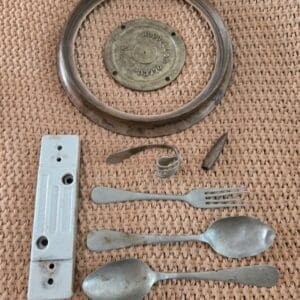
In 2014, Andy raised a Portal while on the Miss Behavin with Captain Jim.


Artifacts we have recovered and restored from the Hebe
Hyde - Experience Level: LE
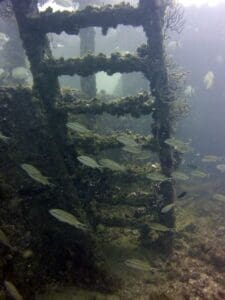
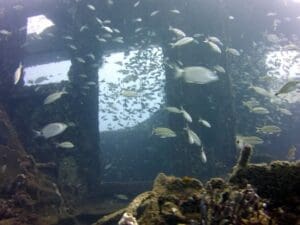
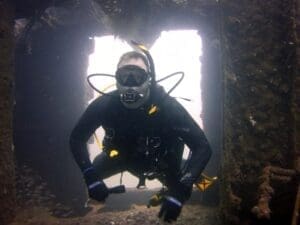
The Hyde is a classic Carolina coast dive—an upright, high-relief wreck with great structure, big fish energy, and seasonal sand tiger shark encounters that make this site a favorite year after year.
Why Divers Love the Hyde
-
Upright wreck = easy navigation along deck lines and superstructure
-
High relief with lots to see in a single dive
-
Excellent marine life: sharks, barracuda, amberjack, grouper, snapper, rays, turtles
-
A “true NC wreck dive” that pairs perfectly with other Wilmington-area sites
Site Details at a Glance
Site Name: Hyde
Wreck Type: Purpose-sunk vessel (artificial reef)
Original Vessel: Ocean-going hopper dredge (built 1945)
Reefed: 1988 (NC Artificial Reef Program)
Location: Approximately 18 miles offshore from Wrightsville Beach / Masonboro Inlet
Orientation: Upright
Depth (Typical):
-
Main Deck: ~65–70 ft
-
Bottom: ~80–85 ft
The Hyde’s Story
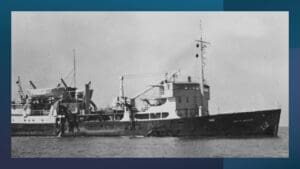
Originally built in 1945 as a working hopper dredge, the Hyde spent decades maintaining waterways and supporting coastal infrastructure. After retirement, she was cleaned and intentionally sunk in 1988 to create a long-term artificial reef. Today, the Hyde is a thriving habitat—and one of the best-known wreck dives off the Wilmington coast.
What You’ll See Underwater
Expect a mix of structure and life:
-
Sand tiger sharks (seasonal highlight)
-
Large schools of baitfish and predatory action
-
Barracuda cruising above the deck
-
Amberjack, snapper, grouper, and reef fish stacked into the structure
-
Sponges and reef growth across the hull and superstructure
-
Occasional turtles and rays
J.D Gill: Experience Level: I
The John D. Gill, locally known as the Gill or WR4, is a casualty of WWII. It was sunk on March 13, 1942 by the German U-Boat U-158. Twenty-three sailors perished when the ship caught fire. It is located 25 miles off of Masonboro inlet and sits at a depth of 95 ft. It is a huge ship at 523ft long making it the largest wreck in divable waters. The wreck lies in two pieces with the bow being the most intact.
 Divers have been visiting the Gill for decades and have been pulling artifacts as rememberance. Numerous brass artifacts have been found including several portholes. A porthole was recovered as recently as 2003 so there is no telling what remains on the wreck.

The Gill is an incredible dive. It is a monstrous wreck which allow for endless areas to search. Marine life is awesome also, it attracts many tropical fish and sharks. There are many sand tiger and sandbar shark sightings. On two occasions I have even seen dolphins which entertained me on my safety stop.
Markum - Experience Level: LE
Sunk in the fall of 1995, Sitting on her side in 80′ of water, her massive hull stretches to within 40 feet of the surface. The Markham has shown many of us how fast the ocean can make art of iron. Marine life including schools of bait fish, amber jack, mackerels and barracuda, as well as the occasional Sand Tiger Shark, make this dive a must-see!!

Experience Level: LE
Normania - Experience Level: I
The Normannia is an incredible dive. Because it is so far offshore it is bathed in blue water most of the time. Visibility averages around 60 ft but vis in excess of 100 ft is not uncommon.

The Normannia is a 312 ft. long freighter that was over taken by rough seas in 1924. It was carrying a load of mahogany logs from Jamaica to Charleston SC. It sunk in 110 ft of water 35 miles southeast of Masonboro Inlet. Now the wreck sits upright on the bottom. The 80+ years the wreck has been on the ocean floor has left a shell behind. The outline of the wreck is clearly visible with it structure collapsing in on itself. The boilers, engine room, bow and stern remain somewhat intact and comprise the major structure of the wreck.


Experience Level: I
Papoose (WE Hutton) - Experience Level I
Sitting upside down in the sand, the Papoose is one of our most popular wrecks for seeing the current inhabitants, sand tiger sharks! Divers looking to penetrate may do so in several places and may work their way internally as far as the boiler room; however, penetration of this wreck is recommended for certified wreck divers only. The Papoose is a 412-foot tanker that was torpedoed by the U-124 on March 18, 1942.
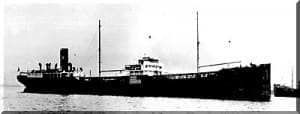
The ship is largely intact and rests upside down in 125 feet of water. This site is one of the most popular shark sites that we visit. On any given day, there are approximately 15-20 sand tiger sharks that inhabit the ship and surrounding areas, if not more! If sharks are on your list of things to see, this is the site for you!! This site is visited on our Full Day Dive Trip.
- Name: Papoose (aka W.E. Hutton)
- Date Sank: March 18, 1942
- Type: Tanker
- Depth: 120 feet
- Length: 412 feet
- Penetration: Limited
- Skill Level: Intermediate
- Sharks: Yes, Sand Tigers
Raritan - Experience Level I
The Ship
- Built by the Detroit Shipbuilding Company in Wyandotte, Michigan.
- Length: approximately 251 feet (76 m).
- Beam: 44 feet.
- Gross tonnage: approximately 2,649 tons.
- Powered by a triple-expansion steam engine driving a single propeller.
Detroit Wayne Era (1932–1940)
After spending years as a cargo vessel, the ship was transferred to the U.S. Army Corps of Engineers and extensively modified into a dredge.
As U.S.E.D. Detroit Wayne, she worked on navigation and flood-control projects along the Mississippi River system, helping maintain commercial shipping channels throughout the lower river basin.
Raritan Era (1940–1942)
In 1940 the vessel was sold, renamed Raritan, and converted back into a cargo ship.
During World War II she carried military and commercial cargo throughout the Caribbean and Atlantic. Her final voyage began in Colombia carrying a cargo of coffee bound for New York.
The Story of the Raritan
On February 25, 1942, the 250-foot freighter was heading north carrying a heavy cargo of coffee to New York. Because of the intense German U-boat threat active along the Atlantic coast at the time, the crew was advised to hug the coastline closely.
Unfortunately, it was a rough, stormy night with poor visibility. Unbeknownst to the captain, the Frying Pan Shoals lightship had been intentionally withdrawn due to the wartime blackout protocols. Disoriented by the weather and lacking the light beacon, the vessel hard-grounded on the treacherous shallows of Frying Pan Shoals.
Fortunately, the U.S. Coast Guard Cutter Calypso successfully rescued all 29 crew members. A few hours later, as the tide rushed back in, the Raritan drifted off the shoal, broke completely in two, and sank into deeper water.
Today, she rests in roughly 90 feet of water. Because her bow and stern sections remain largely intact, she has become an incredible artificial reef teeming with marine life—frequently visited by local divers and schools of sand tiger sharks.
How the Wreck is Laid Out on the Bottom
When the Raritan drifted off the shoals and sank in roughly 85 to 90 feet of water, the stress of the grounding and the weight of her heavy coffee cargo caused her steel hull to fracture. Today, the wreck is essentially broken into two distinct major sections, resting on a flat, sandy bottom:
-
The Bow Section: The bow rests on its side, providing a massive profile that rises up off the ocean floor. Divers can easily identify the forward cargo holds and machinery. Because it sits high, it acts as a perfect structural catalyst for massive schools of baitfish and pelagic predators.
-
The Stern Section: The stern sits relatively upright compared to the bow. It features the remains of the engine room, propeller shaft area, and steering gear. The collapse of the midsection means there is a debris field separating the two halves, scattered with structural steel, piping, and remnants of the ship's internal framework.
Because the site sits near the western edge of the Gulf Stream, it frequently enjoys excellent visibility (often 50+ feet) and warm water during the summer diving season. The high profile of the broken hull makes it a premier haven for giant loggerhead sea turtles, massive barracuda, and groups of sand tiger sharks cruising through the wreckage.
Rosin Wreck - Experience Level: E
The Rosin Wreck is a large wreck 40 miles south of Masonboro Inlet. It sits in 115 ft of water and rises to about 85 feet. The ship is pretty well-defined. There is a giant swim-through where the superstructure of the wreck has rusted away, leaving only the ribs of the ship. Thousands of baitfish, grouper, and even sand tigers are all in the massive swim-through. Experience Level: E
Sherman - Experience Level: LE
Originally a 200 ft. blockade-runner, this 120-year-old post-Civil Ware wreck lies 52 feet of water about 6 miles from Little River Inlet. Always surrounded by multitudes of marine life, the Sherman also offers a variety of artifacts for the careful hunter. US belt buckles, buttons, bottles, and fossils have been found on this site. Open Water Students can complete checkout dives 3 and 4 on this wreck.
Experience Level: LE
Spar - Experience Level: I
The Coast Guard Cutter Spar was sunk as a diver-friendly wreck just yards from the Aeolus. The Spar is known as a popular spot for Sand Tiger Sharks. The 180 feet long and 37 feet wide Spar sits at a 45-degree angle in 100 feet of water and is completely intact, allowing many opportunities for a diver to penetrate the wreck.

The Spar is a great wreck for penetration diving as it is very open and has plenty of places to explore. Divers who don't wish to penetrate often start their dive around the main wheelhouse and move forward to the main deck. Sand tiger sharks usually swim along the crane, and divers frequently bring back a souvenir shark's tooth found lying on the wreck.
The Spar got its name from the US Coast Guard Motto "Semper Paratus, Always Ready," which was an appropriate name for the Coast Guard buoy tender commissioned in June 1944. Making port at various locations up and down the Northeast US, the Spar was one of the most awarded vessels in the Coast Guard fleet and served in a variety of missions during its 50-year service, including submarine hunting and oceanography assignments. After being decommissioned in February of 1997, the ship was sunk as an artificial reef off the coast of Morehead City.
- Name: Spar
- Date Sank: June 2004
- Type: Coast Guard Cutter
- Depth: 110 feet
- Length: 180 feet
- Penetration: Lots
- Skill Level: Intermediate
- Sharks: Yes, Sand Tigers
Stone Tug - Experience Level: LE
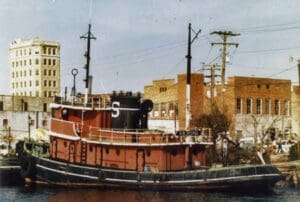
The R.R. Stone is a small tug lying upright in 65ft of water 14 miles out of Masonboro Inlet and is about 10 miles of Carolina Beach. The Stone was sunk as an artificial reef in 1985. It is located within a few hundred yards of the Old Dredge wreck and the Pocahontas. It is a small (85ft long) but fun wreck to dive.
The bridge now sits upside down off to the ships starboard side. Sand Tigers make this wreck there home during the summer months along with the typical inshore fish.
U-352: Experience Level: I
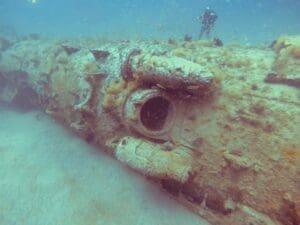
The U-352 was a German submarine that operated during the notorious U-boat attacks of World War II along the North Carolina coast. She was a Type VIIC U-boat, built for Nazi Germany’s Kriegsmarine and commissioned in 1941, tasked with disrupting Allied shipping across the Atlantic.
Operation Drumbeat (1942)
In early 1942, Germany launched Operation Drumbeat, an aggressive campaign targeting the U.S. East Coast following America’s entry into the war. At the time, coastal defenses were limited, and merchant ships often sailed without escorts—many visible from shore at night.
U-352 was assigned to patrol the waters off Cape Lookout and the Outer Banks, hunting merchant vessels and military traffic just miles from the American coastline.


The Final Battle – May 9, 1942
On May 9, 1942, U-352 encountered the U.S. Coast Guard cutter USCGC Icarus near Cape Lookout.
-
U-352 fired a torpedo at Icarus but missed
-
The torpedo’s wake exposed the submarine’s position
-
Icarus launched a swift depth-charge counterattack
-
U-352 was critically damaged and forced to surface
With no chance of escape, the German crew abandoned and scuttled the submarine to prevent its capture.
Casualties and Survivors
-
15 crew members were killed during the attack
-
33 survivors were rescued by the U.S. Coast Guard
-
The survivors became prisoners of war, among the first German POWs held in the United States
Discovery of the Wreck
The wreck of U-352 remained undiscovered until 1974, when it was located by Captain George Purifoy, owner of the Olympus, along with several friends. Its discovery cemented the site’s place as one of North Carolina’s most historically significant shipwrecks.
Since then, the story of U-352 has been widely documented and televised, including features on the History Channel, and it has become one of North Carolina’s best-known and most iconic dive sites.
U-352 Today
Resting in approximately 110 feet of water, U-352 lies on her starboard side, partially collapsed but unmistakable. Now covered in marine life, the wreck serves as both a protected war grave and a powerful reminder that World War II was fought just off America’s shores.
Vermillion: Experience Level: E
The Vermilion Artificial Reef is one of the most significant offshore reef sites in the Carolinas, built around the former U.S. Navy attack cargo ship USS Vermilion. The vessel was constructed in Wilmington, North Carolina, during World War II, where it served the U.S. Navy transporting troops, vehicles, ammunition, and supplies during and after the war. Following decades of service and time in the reserve fleet, the ship was ultimately designated for use as an artificial reef.


On August 24, 1988, the Vermilion was intentionally sunk offshore to create a deepwater artificial reef, becoming one of the largest and most prominent reef structures in the region. The site lies roughly 30+ miles offshore in open Atlantic waters and sits in approximately 130 feet of water, making it one of the deepest public reef sites off the South Carolina coast. Because of its distance from shore and depth, the Vermilion is considered an advanced offshore site, with trips highly dependent on weather and sea conditions.
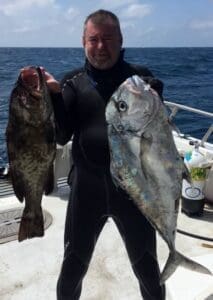
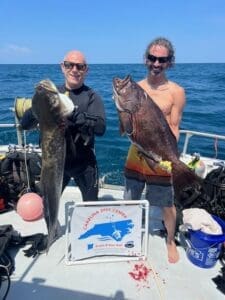
Over time, the Vermilion reef complex has expanded beyond the original ship. Additional reef materials—including subway cars and a retired tugboat—have been added nearby, increasing habitat complexity and vertical relief. Today, the reef supports a thriving marine ecosystem and attracts large schools of reef fish, pelagics, and seasonal visitors. For divers, the Vermilion offers an impressive blue-water experience: massive structure, excellent fish life, and the unique opportunity to explore a WWII-era vessel that has been reclaimed by the ocean and transformed into a living reef.